Thursday, January 24, 2013

Secrets of Seed Starting

I love January as it kicks off Garden Season with seed starting...the first green to be seen in some time.  I start my plants indoors and it is so comforting to see the fresh young plants growing every day.  I keep the starter shelf a few feet from my desk so they are a constant reminder of things to come.  But seed starting can be difficult for the beginner.  Through trial and error, I have developed a system, borrowed and stolen from others really, that is very reliable and fairly inexpensive to build and lasts for many seasons.

Nothing I'm about to say is actually a secret or original but it's what I have found to enable consistently successful seed starting for most vegetables and other annuals.  If you follow these basics, you will be successful.  If I can do it, anyone can!

Foundation Keys to Successful Seed Starting
You must do ALL of these things well to start seeds.  Any variation in the execution of any of these items will successfully diminish your success.  So here they are:

  1. Good, Well-Drained Seed Starter Soil.  I've been told by A&M and other "authorities" that your seed starting mix must be sterile.  However, I've been using horse manure in my mix with excellent results.  Actually, I believe that it is the SECRET INGREDIENT that prevents a lot of problems such as damping off disease that other people experience.  Other than that, the recipe is pretty typical to produce and nice, tilthy, well-drained mix:
    1. Peat Moss - 3 parts
    2. Vermiculite - 2 parts
    3. Fine Sand - 2 parts
    4. Horse Manure - 2 parts
  2. Water from Below.  Once you have your soil prepared, you are ready to start planting.  When choosing planting containers, the main thing to think about is that it should be set up to water from below.  Above watering is one of the key causes of damping off disease.  You can use almost any kind of container but I like the self-watering kits.  My favorite is the Propamatic which comes in 24 cell and 40 cell kits.  I like the 40 cell version because I like to maximize my shelf space.  I grow between 1 and 2 thousand plants each spring so space is a premium.  They also come with a plastic dome which helps with initial germination.  I STRONGLY RECOMMEND these kits.  They pay for themselves in a season and last for years.  Planting is easy:  Wet the felt wick pad and set up the seed starting kit.  Add soil and plant your seeds.  I suggest planting the same species of seeds so that germination is uniform.  Once planted, water from below and rewater as often as you need to keep the soil consistently moist.
  3. Light from Above.  Good lighting is also important.  Many people try to start seeds in south facing windows and other indirect lighting situations but this will produce long, scraggly plants.  Of course you can go with the expensive plant-specific lights, but I'm too cheap for that.  I use the cheapest fluorescent shop lights I can find.  My shelf is rigged with two sets of two 4-ft. lights on adjustable chains.  I adjust the lights so that they are always nearly touching the plants.  The plants can actually grow around the lights and gain some additional warmth.  One set of 4-ft lights will support 4 propamatic boxes or 160 plants!  I run the lights on a timer from 12 to 18 hours per day...the more light, the faster the growth.
  4. Keeping the Plants Comfy.  Seeds and comfy plants enjoy consisted, moderate temperatures.  I start all my seeds indoors where the temperature varies little from 68 to 78 degrees.  I've had good luck with both cool season seeds such as broccoli and spinach as well as all warm season vegetables and annual flowers.  Some folks will start their seeds in a garage or other unheated space that is protected from frost but I can say with certainty that the starts are much slower when the temperature is colder.
  5. Roof Over Their Heads.  My propamatics come with a 2 inch plastic dome that I leave on the units until the seeds have sprouted.  Once sprouted (for tomatoes, they will be touching the top within 5 days of seeding!), remove the top.  Once the top is remove and the plants begin the grow, watering will be necessary more frequently.  At this point, I start watering with a mild liquid fertilizer.
That's it!  You should have strong plants ready to transplant between 2 and 4 weeks depending on how big the plants are.  Be careful about leaving them too long in the propamatic as the roots will make themselves at home in the felt wick and will be ripped off when you transplant.

Timing is pretty easy to calculate.  Work backwards from when you want to plant your garden by subtracting 6 weeks from your plant date.  This is your seed starting date and should provide plenty of time to grow some great transplants.


Sunday, March 11, 2012

My New Mueller's Greenhouse

A greenhouse in Texas has many benefits including extending the growing seasons (on both sides of summer), overwintering tropical and frost sensitive plants, and (my biggest purpose) getting an early start on seed starting, especially tomatoes.  I completed my greenhouse in January and filled it with over 600 tomato starts, a half dozen geraniums, and a couple of hibiscus plants.  I get a wonderful feeling every time I drive by my home and see the green and big red blooms in an otherwise dreary winter landscape.


I have several of the plastic-covered portable greenhouses which have been very reliable for 5 years.  They are small and easy to heat with a small electric heater.  They are vented so I can open up the sides and gables to allow air flow and cooling.  However, the plastic begins to deteriorate in 5 years and must be replaced.  My biggest complaint is the both the heating and venting was MANUAL, which meant I had to open and close them twice a day everyday during use...no days off or vacations!  They are also not very attractive...not something I would want to look at through my kitchen window every morning.

So, my initial experiences dictated my requirements for my new hobby greenhouse:
  • Attractive
  • Automatic heating and ventilation
  • Made from materials that will withstand our sun (UV) and weather (hail, wind).
  • Long lasting materials with decades of use
  • Last but not least, affordable
The selection process was trickier than I thought.  There are many greenhouse companies out there that provide good kits that include greenhouse and heating/ventilation in a range of materials, sizes, and prices.  The problem I found was that the cheaper versions would not hold up to Texas weather and were unattractive - basically plastic sheeting on PVC or lightweight galvanized material.  The more expensive models were attractive and made of nice material but cost too much - 5 to $10,000.

A Google ad (which I generally abhor) popped up on some screen for a Mueller's greenhouse.  I know Mueller's as they build quality metal buildings all over Texas.  There are two things obvious at first glance at the Mueller's greenhouse:  First, it is the most solidly built greenhouse I have ever seen; built with heavy C-perling, plastic sheets guaranteed to last and not yellow under the sun, with pretty green molding on all the corners.  The second thing that was obvious is that Mueller's had never built a greenhouse before and had no idea how to seal, ventilate and heat it.  In spite of that, I decided to go for the quality and correct any greenhouse-specific problems along the way.

It took some extra work and cost but I'm very happy with my new greenhouse.  It has been in operation for a couple of months with several nights in the 20s and many days in the 80s.  In the next blog, I'll cover the customizations I made to the structure to make it "greenhouse capable".

Mueller's greenhouses come in several sizes.  I chose the 9x12 ft. model because 100 sq. ft. is about the maximum that you can heat with an electric heater.  This model retails for $2095 and comes delivered (and taxed) at around $2400.  I added automatic ventilation, heater and thermostat, custom shelving, plus extra materials for running electric and water lines, caulk and other sealing materials, 4x4 treated lumber for the foundation, and concrete for the anchors for a total of $3400.

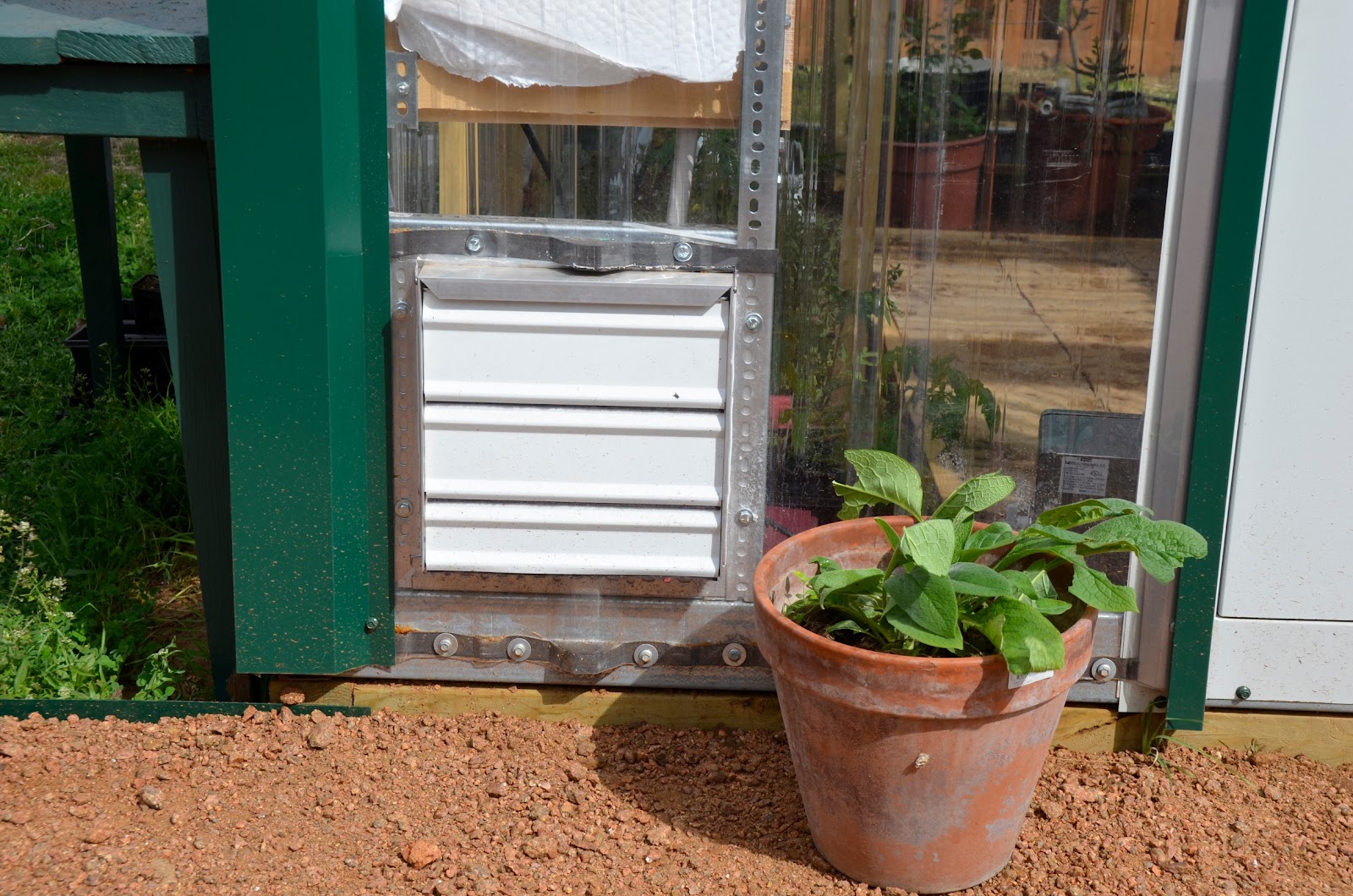
This picture below will give you a general idea of the ventilation and heating system.  The first picture shows the 12" exhaust fan.  The second photo shows the fan speed control, heater thermostat, and ventilation thermostat.  The bottom photo shows the exterior of the 12" intake fan which is electronically controlled.  Crazy Texas weather means that booth systems are frequently used through the winter!


It may seem like this type of system is overkill for a hobby greenhouse but anyone who has a greenhouse in Texas will tell you that if you ever want to leave town for a day, you will need a fully automatic system to protect your plants.  For example, before I had the ventilation system installed in late January, I forgot to come home at lunch and open the windows to allow air flow (I couldn't open them first thing in the morning because it was still freezing!), and when I remembered and ran home to open the greenhouse up, it was 107 degrees and my tomato starts were burning up.  This is a common Texas problem, believe me!

A word on the Mueller greenhouse:  It is a barn with clear sides.  This means two things for the prospective Mueller greenhouse owner.  

First, be prepared to take extra care in sealing every seam with caulk.  Be sure that all the rubber strips are properly aligned.  The biggest surprise for me as the "opening" between the walls and the gables.  It is a one inch gap that runs the length of both gabled ends.  It's probably an excellent idea for barns but a terrible idea for a "sealed" greenhouse.  However, it wasn't a difficult fix.  I just tucked strips of the 1 inch foam pipe insulation into the gap and it was fixed!

The second item to be prepared for is the customization to incorporate the ventilation system into the structure.  It is not difficult but it requires additional tools and some mechanical knowhow.  The plastic sheets must be cut (carefully!) to create the openings for the vent and fan.  I used a dremel tool (be sure to have a lot of cutting disks on hand!).   Additional framing is needed to hold the vent and fan in place.  I used steel L braces screwed into the greenhouse frame...very sturdy!  You can see the framing above.

Since I'm not an electrical genius, I bought a complete ventilation kit from ACF greenhouses.  They were the cheapest I found, had a calculator to determine what size equipment I needed, and had great instructions.  The kit had everything I needed including wire, conduit, etc.

The good news about my Mueller's greenhouse...  It is as strong as advertised.  Everyone who has commented on the structure has been impressed with the construction quality.  Several have opined that they felt the clear plastic sheets should hold up well (which is the number failure point for most greenhouse kits).  It includes aluminum windows on the long ends and a sturdy white steel door with opening window (you won't find this kind of door on any other greenhouse either!).  It's attractive (especially with plants inside) and should last a long time.  


A beginner's take on construction...  This was the biggest home construction project I've ever done and it was fairly easy to put up.  It comes with written instructions and a DVD but the instructions could have been a little more detailed for a beginner for me.  It is definitely a two-man job.  I put more effort in the foundation than they recommended.  I used 4x4 treated lumber anchored in concrete.  I bolted the frame to the timbers and caulked around the edges.  It's not going anywhere!  Mueller's casually suggests bracing the corner wall beams which means....brace them!  Have some material on hand to square and brace the corners.  The rest goes up pretty easy.   Be careful to not stretch the plastic as you mount it and CAULK EVERYTHING!  My biggest regret is that I didn't caulk more.

Finishing touches...  I built my own shelving using 1x6 cedar pickets.  I mounted the shelves on those big beams running down the center of the walls.  This meant that the shelves didn't have to be free-standing and where very sturdy.  I built shelves along both long walls.  You will notice in the picture below that I also built a portable second shelf on hinges above the primary shelf.  I use it for overflow during the spring garden season and it blocks some of the west sun during the summer.  I also bricked the main path with 1x1 ft. paving stones and mulched the rest with cedar mulch.  All of this is on top of a double layer of landscape fabric to prevent weeds from growing inside the greenhouse.


Last thoughts....  This greenhouse is a nice size with plenty of headroom for me and hanging baskets.  The roof C beams are excellent for holding hanging baskets.  I plan on keeping a shade cloth on the greenhouse once it gets closer to summer for temperature control.  You can see both in the photo below.


That's it!  Stay tuned as I'll update you on my new greenhouse in the coming gardening season.


Sunday, June 27, 2010

Periodic Feeding with Compost Tea for Continued Success


I've written about how it is imperative to continue to feed your plants after the initial planting.  I know how hard it gets to continue to care for plants after the temperatures rise up into the 90s.  It seems it takes almost all of my time just watering.  But I have learned that just a little plant food every other week will keep most summer vegetables going much longer...and also reduce stress which results in increased pest and disease problems as well as reduced production.

15 Gallon Homemade Compost Tea Brewer
My favorite "plant food" of choice is compost tea.  It is economical (it costs about $35 to build but virtually nothing to operate) and seems to have the same magical properties that compost has.  I usually add some actual fertilizer to my compost tea and water all my potted plants and raised beds.

If you want to know more about how to build your own compost tea brewer, click on the link under Popular Posts to the right.  There are also some good videos under Natural Gardening Links.

Complimentary Planting for Beauty and Pest Control

I was complaining to my mother-in-law about how my raised beds did not have the curb appeal that the flowers I sell have from the road in front of the store.  She suggested that I do some complimentary planting that would serve both to create a more beautiful garden and provide some added pest protection.  So I planted marigolds, known for their ability to repel insects, basil (for eating), and citronella (the mosquito plant) in addition to four tomato plants in the middle.

Complimentary Planting with Tomatoes, Marigolds, Basil and Citronella
I was pleasantly surprised with how much more attractive the bed was and the plants seem to be doing very well so far.  The crowding hasn't appeared to affect production.

Container Gardening: Great Results for Busy People

For producing a bountiful harvest with the least effort and time, container gardening and raised bed gardening are the best answer.

I differentiate between container gardening and raised bed gardening.  Container gardening is focused on growing in enclosed pots and containers such as flower pots, tubs, and even Earthboxes.  Raised bed gardens are built up from the ground but are open to the soil below.  I make this difference because container gardens are limited by the contents of the pot.  Once they are used up, the plant becomes stressed, stunted and quits growing and producing.  Because of this, constant watering and feeding (ie. constant care) are required of all container plants.  On the other hand, raised beds have more soil and the plants can even make use of the topsoil below the raised bed.  It's the best of both worlds, the benefits of less weeding and care of container gardening, and the increased production potential of ground-planted gardens.

Many people have been disappointed with their container gardens; both in the quantity and quality of the fruit, as well and the constant watering during summer months.  I can grow tomatoes in almost any size pot, but it takes constant watering and feeding.
There are over 40 tomatoes on this plant growing in a lick tub!


Hanging Basket with Two 3/4 Lb. Tomatoes

It is my opinion, raised beds are the best choice for those wanting the grow a good amount of vegetables but don't want or have time to plow, weed, and care for an in-ground garden.  From my experience, several 4x4 foot raise beds and add a good deal of food for the entire family.
Earthbox, 4x4 Raised Bed, Tub Tomato, Wire Trellis

The picture above shows several different type of container gardening options.  The Earthbox (shown in front) has a water reservoir in the bottom that eliminates much water and can be used to provide a constant liquid fertilizer charge.  The raised bed is built out of recycled lumber.  It contains 8 pepper plants, and a row of cantaloup and a cucumber plant.  The cantaloups and cucumbers are trained up the wire trellis maximizing space and minimizing care.  On the left of the raised bed, is a tub tomato.  At this point, I had already harvested a half dozen tomatoes, all of which were over 3/4 lb.  The tomato is tied to the trellis for support.

The raised bed in the background is planted with pole beans, bush beans, onions and a squash plant.

Strange Leaf Curl

The biggest problem I faced this year with my tomatoes was a strange leaf curl that started on the youngest, tender leaves at the top of the plants.  As it turned out, I don't think that the leaf curl affect blossom set or fruit production but here some stuff I learned about it.  Let me know if you found out anything different!
Strange Leaf Curl at Top of Plants
I searched the web for hours and most of the expert sites agreed that leaf curl on the tops of the plants was either pesticide drift damage or stress.  Since there were several folks around town with the same problem, I determined that it was not pesticide drift.  I thought it could be stress as it showed up right after a 7 inch rain but it persisted (and continued to spread) even after it dried out.

Finally I heard from the local extension agent.  An extension specialist from College Station said that it was most likely a microscopic mite that cause the problem.  It feeds on the chlorophyll in the plant and causes the damaged leaf to curl.  There is not visible damage to the leaf other than the curl and you can only confirm the presence of the mite by sending off a sample which takes time and money.  He suggest a foliar spray of liquid sulfur or pyrethrin.  Sevin dust does not work.  Since I don't use chemicals, I decided to try neem oil which is an excellent miticide, at least on red spider mites.  However, these seemed a little tougher than their more common cousin (assuming that the mite was the problem).  I did spray once with neem and the progression seemed to slow and eventually stop, I'm not sure that it was the answer.  I'm also not sure if the the little critters did enough damage to slow the plants down.  For a couple of weeks, I was harvesting around 10 lbs. of tomatoes a day!

At any rate, if you have this problem, you can give the liquid sulfur or the neem oil a try.  They are both very safe.

Great Year for Heirlooms

I'm really behind on my posts so expect a lot over the next few days (hopefully!).  I've taken pictures all along so I have lots of info and pics to share from the past couple of months.

It's been a great year for heirloom tomatoes - all tomatoes actually!  All 20+ varieties of tomatoes that I planted have produced well and provided me and my family a cornucopia of tastes, shapes, and sizes...just what nature intended.


It has been a wonderful spring with one of the largest tomato crops I've ever had including several dozen "pounders" and the largest, a Belgium Giant weighing in at 1 lb. 8 oz., just short of my record 1 lb. 10 oz. Watermelon Beefsteak from 2008.

Most of my tomatoes are in my tomato and pepper garden at The Green House.  Springtime at the store requires that my garden is very low maintenance so  I use a combination of no till and carpet for weed protection.  As with most organic gardens, with a little compost and organic fertilizer, the soil just gets better and better.  I had few pest problems (tomato horn worms of course; corrected with a little Dipel) and a strange leaf curl which didn't seem to affect production (I'll post another blog with details on this).

Here's some pictures from my garden by month:  April, May, and June.
The Green House Backyard Garden April 2010
TGH Backyard Garden May 2010
TGH Backyard Garden June 2010

You can tell it's getting hot but most of the plants are continuing to produce.  In the foreground is an heirloom squash and a couple of Jubilee watermelons with their vines trained along the carpet to keep away from weeds.  Just behind the squash is a couple tomatillos and a 4x4 box of potatoes.  To the left is a row of black-eye peas (seeds bought from the grocery store) and a row of bush green beans.  It seems that Strike is the best bush bean variety for our area.  The second row is a double row of Betty's (my mother-in-law) LaJoe giant jalapenos.  I have a special batch of seeds called #1 Sport which are doing fantastic.  Here's an example pic - and they are still growing!
LaJoe #1 Sports
To the back of the pictures are five rows of 4 tomato plants each; each a different variety.  Both heirloom and hybrids are represented but I haven't noticed the hybrids as having an advantage over the heirlooms in either production or disease resistance.

Hope you are having a great garden year too!

Thursday, April 22, 2010

Organic Pest & Weed Control Lecture

I am speaking at the Mason Spring Round-Up which includes a variety of organic gardening and farming and sustainable living topics.  For those that attended, I promised to post the notes from the lecture.  Here they are.  Enjoy!


Reasons for Use of Organic Treatments
  • Marketing/Certification
  • Environmental
  • Safety – Pets & Grandkids
  • Works Best as Part of Total Organic/Natural Program
Myths of Conventional Agriculture
  • Myth #1: Insects are “Out There” just waiting to Eat your Plants
    • Insects are Designed to Seek Out Weak/Stressed Plants
  • Myth #2: The Only Purpose of the Soil is to Hold the Plant Down
    • There is More Life Under the Soil Than on Earth.  This Life Has a Symbiotic Relationship with Plants to Mutual Benefit.  Any Disruption of this Relationship Causes a Decline in Plant Performance
Treatment Considerations
  • Even Organic Treatments Have Some Risk - Evaluating Level of “Safety”
    • Selectively Targets Species Type/Non-Toxic – BT, Soap
    • Non-Selective/Non-Toxic – Orange Oil, EPA GRAS list
    • Non-Selective/Toxic - Pyrethrum
  • Know What You’re Trying to Get Rid Of
    • Texas Bug Book
    • Make Sure You Need to Get Rid of It!
      • Yes, you have bugs but are they eating anything?
  • Understand Cause of Infestation
    • Will Your Plant Grow Here?
      • Well Adapted Species 
      • Correct Amount of Water 
      • Sun or Shade
      • Soil Drainage
      • Planted in the Correct Season
    • If Yes to Above, Is There Environmental Stress (e.g., drought, excessive rain, etc.)?
      • EX: Drought brings on stink bugs to tomatoes
      • EX: Rainy season causes increase in fungal diseases or nutrient leaching resulting in discoloration
    • Seasonal Change (e.g., increase/decrease in temperature, etc.)?
      • EX: Early summer causes cool season veggie stress attracting harlequin beatles
    • Plant Stress (e.g., heavy feeders or bloomers needing additional nutrition)?
      • EX: Roses bloom themselves into exhaustion
      • EX: Heavy feeders such as tomatoes exhaust soil nutrient supply
    • If All of the Above Are NO, Then Soil Needs Attention
    • Choosing the Best Treatment for The Job
  • Insects
    • Worms – BT or Dipel – Tomato Hornworm. Cabbage Loopers
    • Aphids, Spider Mites, Whiteflies, and Lacebugs
      • Mild Infestations “normal” for many Crops
      • Large Infestations Sign of Soil Issue
      • Treat with Water Blast, Soap, Fish Emulsion/Seaweed, Garlic-Pepper Spray
      • Orange Oil – Non-Selective; Will Kill Beneficials as Well
        • Prevention - Longhorn Farms story...
    • Squash Bugs/Hard Shell Bugs
      • Treat with Pyrethrin
      • Give Bugs Weakest Plant to Eat
      • Squash - Keep mulch away from plant
      • Are Plants Out of Season?
    • Stink Bugs
      • Vacuum/Drop in Bucket of Water
      • Are Plants Out of Season?  Stressed?
    • Fire Ants
      • Mound Treatment - Auntie Fuego Mound Drench
      • Bait Treatment - G/L Fire Ant Control w/ Spinosad
      • Orange Oil, Aspartame, other home-made treatments
      • Diatomaceous Earth (DE) as a Barrier
    • Grubworms
      • Beneficial Nematodes or Sugar – 
      • Indicates Need to Improve Soil
    • Mosquitoes
      • Eliminate Water Sources - Empty Standing Water
      • BT Dunks or Granules for Water Troughs, etc.
    • Slugs, Snails, Land-Bound Critters
      • Hot Pepper, cedar flakes, DE
    • Fleas
      • In lawn, beneficial nematodes
      • In home, boric acid in powder
      • Citrus Oil in shampoo or area spray
      • Cedar oil as barrier
    • Grasshoppers
      • Battery Acid or Flame Thrower
      • Healthy Plants Will Still Resist!
Choosing the Best Treatment for The Job
  • Fungal Diseases such as Black Spot, Powdery Mildew for Ornamentals & Vegetables
    • Horticultural (Whole Ground) Corn Meal
      • An Aggie Invention...
      • For Vegetables and Ornamentals, Generously Sprinkle On Ground Under and Around Plants
      • Won’t Remove Existing Spots
    • Neem Oil
      • India’s Medicine Tree
      • Insecticide, Miticide, Fungicide
      • Indoor/Outdoor
      • All plants, herbs, shrubs, fruits, etc.
    • Sulphur Dust
      • Used extensively in grape production
      • Watch sulphur content in soil
    • Baking Soda/Potassium Bicarbonate
  • Lawn Fungal Diseases such as Brown Patch, etc.
    • Corn Meal at 20 lbs. per 1000 sq. ft.
    • Compost - The Magic Elixer
    • Alfalfa Meal or Alfalfa Meal Mixes
      • Back to Nature - Nature’s Blend
    • Chlorosis (Mineral Deficiencies) – 
      • Texas Greensand
        • History of Over-application of Phosphorous
        • Medina 5-3-4 + Greensand
  • Weed Control
    • Non-Selective Pre-Emergent Horticultural Corn Gluten
      • Must be 9-0-0 - Blends Do Not Work
      • Apply at 1 lb. per 100 sq. ft.
      • High Nitrogen Provides Timed-Released Greening
      • Granular Much Easier to Apply
      • Excellent for Grassburrs - Apply by March 1st
      • TOO EXPENSIVE!
    • Horticultural Vinegar – Natural Round-Up
      • Should be 20% acid to work well
      • Add surfactant – squirt of soap
      • Apply on sunny/warm day
    • Mechanical Weed Control
      • Hoe & Mow
      • Plastic Row Cover, Recycled Old Carpet, Newspapers, etc.
Prevention vs. Treatment
  • Frequent Inspection - Key is to Catch Problem Early
  • Best Defense is Good Great Soil
    • Richard Polk’s Garden Story...
  • Organic Soil Testing
    • Texas Plant & Soil
      • Use CO2 Acids that mimic plant’s action - increase accuracy
      • Use Comprehensive Soil Chemistry Analysis (Albrecht System) to make recommendations/calculations
      • Pages of personalized recommendations for your crop/soil profile
  • Creating Biologically Active Soils
    • Compost & Manures
    • Actively Aerated Compost Tea
References
  • Understanding how Plants Literally Signal Insects to Come Devour Them: Tuning Into Nature by Phil Callahan
  • Identifying Pests and Organic Solutions: Texas Bug Book by C.Malcolm Beck and John Howard Garrett
  • Soil Food Web and Compost Tea: Teaming with Microbes: A Gardener’s Guide to the Soil Food Web by Jeff Lowenfels & Wayne Lewis
  • Organic Soil Testing: Texas Plant & Soil at www.TexasPlantAndSoil.com or call at 956-383-0739.
  • For a copy of these notes, compost tea recipes and many links to natural and organic resources, visit my blog at www.NaturalGardener.blogspot.com

Sunday, April 18, 2010

Potassium, Phosphorous Levels Declining in the US

I am constantly reminded that food and health are tightly linked...and this link shows up in funny ways.  I was just researching for our natural health newsletter and came across an article on the declining availability of agricultural phosphorous and potash (the P and K in N-P-K on your fertilizer bags).

The article, entitled "Falling Potash: Stop the Impending Agricultural Collapse", was printed on a national natural health website.  According to the article, readily available potash (mined from the earth) is rapidly declining and fertilizers producers are having to transport the mineral longer distances using much more fuel.  My Dad, who runs the local feed and fertilizer store, mentioned that much of our fertilizers components are being exported to China which has been driving up prices.  Neal Kinsey, a well-known agricultural consultant whom I've trained with, told us during class (about 5 years ago) that a dozen of the largest families in the US have been quietly buying up mineral rights and mines across the country...cornering the market.  He expected then that prices would rise.

The same article mentioned that phosphorous stocks have been on the decline since the 1970s.  I've experienced this first-hand when Lonfosco, the manufacturer of Malcolm Beck's Soft Rock Phosphate, ran out of material a couple of years ago.  While there is other soft rock phosphate, it is harder and less available to the plants.  http://www.NaturalNews.com/028495_agriculture_potash.html


Impact on Organic Gardening/Farming
For organic farmers and growers, it is less of a problem.  Potassium is relatively abundant in manures and composts.  For those needing to build their soil,  Texas Greensand, mined here in Mason county, is loaded with potassium as well as iron and many other trace minerals.  I recently learned from a Master Gardener friend that greensand is actually fossilized trilobite poop...dinosaur poop?

Phosphorous is a little more interesting.  Malcolm Beck is the guy that discovered that the best way to apply phosphorous is by dusting the hole or row directly beneath the roots with soft rock phosphate (SRP) would increase yields by 20%.  Phosphorous is about the only mineral that doesn't move through the soil and has a nasty habit of locking up essential trace minerals.  By placing the SRP near the roots, the plants take it up before it has a chance to bind with other minerals and become unavailable.  If you use this technique, it may be worthwhile to stock up on SRP while it is still available.  Garden-Ville's Rock Fuel is a transplant fertilizer loaded with SRP and is an excellent alternative to straight SRP.

Chicken manures and composts are loaded with phosphorous and there probably is adequate phosphorous in most good composts.  Bone meal also has 12% phosphorous if you can find it.

Soil Biology and the Soil Food Web
Dr. Elaine Ingham has been researching the soil food web and all the microscopic creatures that inhabit this underworld.  She has learned that these guys live in symbiosis with plants and produce many, if not all, of the nutrients a plant needs.  Actively aerated compost tea is a method she came up with to inoculate soil with these guys to help provide plant nutrition and protection against disease and pests too.  This is an inexpensive method requiring little inputs (molasses and a shovel of good compost) and may be the future of agriculture.

What Does All This Mean?

Well, for conventional agriculture farmers who use copious amounts of these minerals, productions prices will increase meaning food prices will increase.  Eventually farming practices will change and the old wasteful methods will disappear.

In the short term, it most likely means food prices will continue to increase and food quality will continue to decline.  

Another good reason to grow your own food!

Saturday, April 17, 2010

Losing Access to Seeds

On the way to speaking to the Llano Master Gardeners, I found out that Parks Seed, a major retail consumer seed company, filed bankruptcy.  It's another example of the loss of access to many varieties of seeds we are encountering.

At the Master's Gardeners meeting, my talk was on heirloom tomatoes.  One of my main reasons for planting heirloom and open-pollinated varieties is that I can save my own seeds and not be held hostage of the seed companies.  One of the challenges we face is find open-pollinated varieties that do well in our hot summers.  This year, I am trying Rutgers, an old time favorite before the introduction of Celebrities.  I am also trying F2 varieties (saved seeds from hybrids) to see how they will do.

Heaven forbid, if there ever comes  a time when we have to grow at least some of our own food, we will need seeds that we can save and share without the need for mega-seed companies and genetically-modified foods.

Stay tuned this summer for a visual lesson on how to save tomato seeds.  It is easy and produces highly viable seeds.  In the meantime, happy gardening!

Sunday, April 4, 2010

A Visit with the Extension Vegetable Specialist

Anyone who knows me knows that I don't have much respect for the agricultural programs at Texas A&M.  However, I find it interesting that one of their most popular spokesmen (and the only exception to my "I have all A&M agricultural experts") is Dr. Jerry Parsons.  I listened to him speak at the Llano Master Gardeners last week and what amazed me is that he has been listening to the complaints of many gardeners on a range of topics and has responded with some good advice and solutions.  Here's some examples:

Saving the Lost Hybrid Varieties.  We have been losing our best hybrid tomato seeds for several years including Bingo, Merced, Heatwave and many others.  The consolidation of the seed companies has resulted in the loss of many hybrid varieties as well as expensive hybrid seeds.  Solar Fire and 444 seeds cost 20 cents a seed - to the wholesale grower!  Jerry's response has been to trial saving F2 seeds (the offspring of the hybrids).  Apparently we've been told that you can't save seed from hybrids because you lose the positive characteristics in the children.  However, Jerry knows that tomatoes are 85-90% self-pollinated.  He is collecting old seed stocks from across the state and is saving and testing seeds of these old hybrid varieties.

The Value of Manures.  Another funny story from Dr. Parsons was his (and all Aggies) that they could grow any tomato as well or better with conventional methods; specifically chemical fertilizer.  Apparently, they tried for years but gardeners kept growing huge tomatoes with manures and composts and they couldn't compete.  Not to be wrong, Dr. Parsons now recommends manures and composts as one of the best soil amendments to growing vegetables.

Heirlooms.  As much grief as I receive from Dr. Parsons and other Aggies over the years, I can't believe that he would even be talking about heirlooms much less putting them on his website.  But, low and behold, heirlooms are a topic.  He shared something that I had not put into clear words yet about heirlooms.   Most of the heirlooms we get are varieties from the north.  This is why I can plant them early and get good results but they do not work when planted later - no heat tolerance!  However, there are some old southern heirloom varieties that he talks about on his website and I will begin growing this year.  One is Rutgers, probably the most popular tomato variety before Celebrity was introduced.

Seed Bank.  The extension service has developed some really interesting and vigorous producing varieties of peppers and other veggies that never made it to market.  These, along with other open-pollinated and F2 hybrid varieties are available to the public through his seed bank.

Plant Answers.  On a final note, Dr. Parsons is funny and interesting speaking (if not a little annoying sometimes...) AND he knows his stuff.  He tests everything so if he says it, its because he's actually done it or seen it himself.  No "theoretical stuff" here!

If you are interested in his website, it has a lot of great stuff and a huge database of answers to typical gardener questions...definitely worth a look.  www.plantanswers.com

Spiffing Up Your Store-Bought Veggies

This post is for those of us whose can't grow everything they eat.  Or, how to clean and freshen your store-bought veggies...

I learned this trick from my wife who learned it from someone in the restaurant business.  It is an old restaurant trick that gets the limp out of your veggies but it also helps remove harmful bacteria and other toxins.  So enough talk, here is the trick:

Fill the sink with water (about half full leaving room for your veggies) and a half cap of bleach.  Place your veggies in the sink and let them soak for 20 minutes.  Drain and fill with pure water and let the veggies sit another 20 minutes.  Repeat.  Let your veggies drain and dry for a few minutes and put them in the fridge.

You will be amazed at how freshness and crispness will be restored to lettuce!

Friday, March 26, 2010

The Winds of March

Spring is Sprung...well, almost.  I missed posting last Sunday mostly because I didn't have anything new to report.  It is just not quite time to plant the summer garden yet.  We had a frost on Sunday that was so hard it nipped my Celebrities in my unheated greenhouse.  The last three years have seen a frost in April not to mention 3 years ago when it snowed on Easter and stayed around 32 for several days!  So, my advice, don't let the March spring days fool you.  WAIT!...just a little longer, I promise.

Heirloom Tomatoes Are Ready.  My heirloom tomato starts are just about ready for transplant.  They were started on Feb. 1 so that is just about 6 weeks.  It really is good for the plants to give them an extra couple of weeks so I'm planning on planting them in two weeks.  Some people are just now trying to start seeds - it is too late...sorry!  Six weeks will put their transplant time May 1st which means they will be trying to set in some serious heat.  Actually it may work; it just depends on the weather.

Starting Peppers.  I don't start my peppers especially early.  Unlike tomatoes, peppers refuse to grow until things warm up.  I started a wide variety of peppers, including my mother-in-law's LaJoE (Largest Jalapeno on Earth - yes it reaches lengths of 6 inches or more!), about 10 days ago.  Pepper seeds are a little slower to sprout than tomatoes but they are up and starting on their first mature leaves.  They should be ready for transplant by the end of April and that is just about right for this country.

Starting Summer Veggies.  Lots of people start many of their summer vegetables directly in the garden, but I like to start my own melons, cucumbers and squash, protect them in the safety of my greenhouse, and pick the biggest and strongest plants for my garden.  This is the easiest of all the seedling starts as they would probably sprout in saw dust!  It does give me a little head start in advance of our last freeze date of around April 15th.

Starting Fall Tomatoes.  Surprisingly, around May 1st is the time to starting fall tomatoes!  Add six weeks to transplant (Jun 15th) and 75 days to fruit and you're in September.  That will give you a couple of months of tomatoes before the first frost in mid- to late- October.  Starting fall tomatoes is a good idea especially if you like determinate varieties, such as Celebrity, which produce their crop and die.  You may want to mark your calendar as it is difficult to worry about a fall garden in the middle of weeding and watering in May.

See you in the garden!

Sunday, March 14, 2010

Container Gardening

I posted a lengthy discussion on container gardening last year (see Popular Posts) and it has all the essentials on preparing the soil, planting, and successfully growing your veggies in any type of container; raised bed or otherwise, but I wanted to talk about it again BECAUSE I LOVE IT...and here's why.

For shear volume, there is nothing better than an in-ground garden, BUT...  labor is significant!  Tilling, weeds, pest control, etc.  Everything is bigger...including the problems.  We are so busy at the store in the Spring that it is difficult for me to have TIME for my own garden.  I need a garden that fits my schedule.  Talking with my customers,  TIME may be the biggest shortage we all have - more than money!  So here's some ideas on container gardening that don't take much time to set up and are a breeze once they are going.

Square Foot Garden.  The obvious is the small square-foot garden made famous by Mel Bartholomew in his book Square Foot Gardening.  One of the main points I got from his book was this.  We tend to garden like commercial farmers but our goals are not the same.  The farmer uses mechanical tools and usually farms a huge quantity of a few crops in huge fields.  We small gardeners are just the opposite relying on manual labor and growing a wide variety of crops in confined spaces.  Bartholomew showed me that I can grow a lot of different crops and produce enough for my family and friends in small spaces with less work than my traditional in-ground, row garden.  One of the main ideas I got from him is that more plants planted closer together grow more total produce PER SQUARE FOOT than my row garden.

The picture above shows two 4x4 foot square gardens; the left with 16 broccoli plants and the right with 8 cabbage, a 2x2 plot of carrots, and a 2x2 plot of onions.  Nearly invisible is a welded wire trellis arched between the two beds.  Once the cool season veggies are done, I will plant cantaloupe, cucumbers, tomatoes, and pole beans and train them on the trellis.  The remaining 3/4 of  the beds will be dedicated to tomatoes, squash, egg plant, or bush beans.  I am adding two more 4x4 beds this year and will be able to produce most of the veggies I want for my entire family.  The benefits including superior soil, less watering and weeding, and less bending over.

Recycle Old Containers.  There are many other kinds of containers that can be extremely easy to use for particular crops.  Here's an example of styrofoam boxes used to ship grapes to grocery store being used for lettuce.  Two or three of these can be seeded every 2-3 weeks giving you plenty of leaf lettuce for about 8 months out of the year.  The red teepees in the background are actually walls-of-water with early season heirloom tomatoes inside.  According to some university research, the red increases yields.  The walls-of-water protect the plants from frost (down into the low 20s) and wind.  They are one of the best early season tools for southern gardeners.  They tomatoes are planted in old 200 lb. cattle lick tubs with the same soil mix I used on the  raised beds.  I will secure the plants to the side of the trellis for support.


Earthboxes are another favorite of mine for people who are away from home and can't water every day during the summer.  The bottom of the container contains a reservoir which holds about 2 gallons of water.  With the top mulched, that will last up to five days in the summer heat.  This one is shown with a red/green leaf lettuce mix.


Make it Fun.  Here is my first strawberry of the year in a hanging basket.  I also plant container variety tomatoes such as Tumbling Tom in hanging baskets.  In our summers, a deep basket with a small reservoir for water is best.  Otherwise, you will be watering twice a day.

What to Avoid.  I have not had luck with the upside-down containers and neither have any of my customers.  I bet that a dozen people tried them last year with no success although last year was a terrible year for gardening - 102 degrees for a couple of months!  Here are some other things to watch out for when choosing a container.  Be sure that the container isn't contaminated with something you would want in your produce.  This may include pesticides, herbicides, and treated lumber.  Also, color can make a difference.  I local gardener was growing tomatoes in black lick tubs and was having to water twice a day and the plants were still suffering from the heat.  He painted the tubs a lighter color and problem solved.  Be sure to fit your container to your plant - bigger pots for bigger plants, etc.  Also, be sure to site your container keeping in mind your plants' light requirements.  Don't forget that the trees don't have leaves yet!

Monday, March 8, 2010

Seed Starting Week 5 Update


Quick update on the seeds I started on February 1st.  As you can see, they are in good shape and on track to be ready for transplant at six weeks.  These are some of the best seed starts I've every had.  I attribute that to several things:  1) practice, practice, practice...as seed starting is an art.  2) placing my starting rack under central heat with constant ideal temperatures, and 3) mixing a large dose of organic fertilizer directly into the transplant mix.

So, if you live nearby and are interested in organically grown, beautiful heirloom and hard-to-find tomato varieties, reserve yours now.  They go pretty fast once the spring season gets started.


Herbs Upon Us!

I went to Nature's Herbs in San Antonio and picked up our first load of herbs.  I love buying from small, family-owned growers.  When families are involved, there is more care, love and service in the plants...and it shows.

Plant Many Herbs Now.  While it's too early for Basil and other annuals, it's OK to plant the perennial now.  Rosemary, Thyme, Mint and Lavender can be planted now without worry of frost.  Cool-season annuals (and biennials) such as Cilantro, Fennel, Dill and Parsley can also be planted.

I love herbs because they have wonderful smells, textures, and generally take very little care.  Most like sun but can stand some shade.  They generally need good drainage and can stand some drought and heat.  Just throw a little organic fertilizer in the hole when planting and you're off to a good start!